Monday, November 3, 2008

Just thoughts

Just wanted to put a few things out there that I was thinking about class and haven't had a chance to try and process.

What did people think of the man holding the seashell to his ear?  I thought of the seashell as an amplifier.  Since when you put your ear into the seashell you hear everything more clearly and can pick up more I thought that this may be related to the gay black male voices that hadn't been heard by mainstream society.  I was also struck by how out of the norm it was to have a seashell like that laying around for use like that so I wanted to think about it in a bit more depth and see what people thought.

Also what role does poetry play in this film?  I thought it was difficult to read each scene because there seemed to be so many layers to each part.  Not only do you have the way in which it is filmed with light, color, depth, spacing and much more to consider, but also the poems being laid on top of those.  To me it was a lot at once, but wondered if anybody had any thoughts of how the poetry changed or added meaning to each scene?  Or any one scene in particular?  I wish we had gone over the poems and looked at them a bit before we watched the movie so we had a bit more of an idea what the movie was trying to say before we saw them combined.

I think it was one of the first poems that was read, but one of the poems mentioned fields of poppy and specifically red poppy [I think another was mentioned as well] and I was wondering if anyone had any idea why poppy's were chosen?  I thought it might have been because poppy's are in cocaine and that's a drug commonly associated with homosexuality?  Also I thought it was interesting to have color mentioned in a poem overlaying a black and white film and it just stuck with me.

So lots of questions coming from someone that felt a little overwhelmed by the movie...but oh well, go vote.  Obama.  Not McCain.

Tuesday, October 28, 2008

embedded.net

After my anxiety attack in Priya’s office today I calmed down, sat down at my computer, and really searched for information on my topic. And I found some really interesting stuff, but one site really stood out to me, http://www.unembedded.net/main.php. This project that these four independent photojournalists are doing in a sense, is what my project is about. They have written a book and started an exhibit where they are trying to show the American public what is really going on in Iraq. The photos that I looked at were all really interesting, but the ones that were really moving (even though they were pretty bloody) was Ghaith Abdul-Ahad.

This exhibit is traveling around the country right now and the crazy thing is, it could come here. They have made it so accessible to the public. All they have to do is accept it.

Wednesday, October 22, 2008

Mulvey in the standard Hollywood shoot-em-up

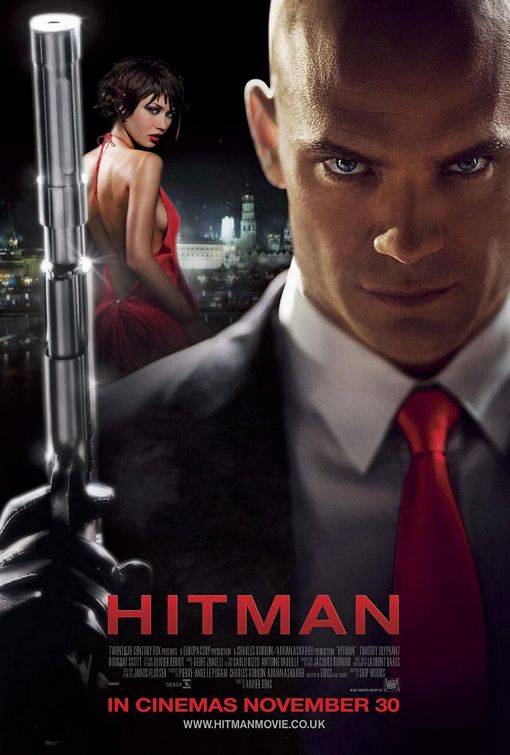
Mulvey's characterization of the use of (and literal, erotic viewing of) female figures in cinema as an oppositional force to the male-driven narrative that must be overcome brings to mind two similar recent flicks: "Hitman," starring Timothy Olyphant, and "Casino Royale," the most recent James Bond movie starring Daniel Craig. 

In "Hitman," Olyphant portrays what else but a genetically engineered hitman who is very good at what he does. There is a very funny scene involving the female interest of the movie, played by Olga Kurylenko, in which she has become very drunk and attempts to seduce '47,' the hitman. It's very much the 'sex scene' of the movie, and can easily be described through Mulvey as a scene that "unwinds magically, indifferent to the presence of the audience, producing for them a sense of separation and playing on their voyeuristic fantasy" and a glimpse at the pair's hotel room existing as a "private world" (324). Kurylenko's character has been sexualized throughout the movie until this point, and it would seem only inevitable. While Mulvey's theory of the female as causing a "castration anxiety" is a bit extreme, this movie turns the hero on it's head in a funny and poignant way: Instead of what one would be presume the 'cut to our hero and woman, having a post-coital cigarette,' '47' knocks her out with a gadget or tranquilizer of some kind--he's very awkward throughout the whole scene, the implication that he is somehow sexless or refuses to have sex with by merit of the science fiction of his being a clone and genetically engineered for one purpose: to kill. He continues to drive the narrative, but this shortcoming remains unresolved: is he castrated by her? Does Mulvey's theory fall short for this movie? Or is it simply taken as a humorous resolution to the obligatory 'sex scene' of the movie, the voyeuristic filmmaking opprotunism that seems so common in almost any R-rated movie?


Similarly, in Casino Royale, lothario James Bond's love interest, Vesper, also seems to present a threat of castration in the sense of disallowing the male figure to not continue driving the narrative: in this origin story of James Bond, he actually falls in love with her after a rather horrific part of their adventure and what amounts to a torture scene involving literal castration. Interestingly, Vesper becomes to Bond a reason for leaving his globe-trotting, womanizing and killing-laden career with British MI6 and there is a scene where he actually tenders his resignation to the higher-ups while planning on how to live his life out with Vesper. This could also be viewed as a castration of sorts, the manly figure of James Bond brought to retirement not by the Russians but by love? No longer shooting his gun and his mouth off at every opprotunity, but rather living a peaceful and monogamous life? It's a nice thought, but short-lived: It turns out that Vesper is *SPOILER ALERT* working with the bad guys, and even though James kills them all, he cannot save her in the end. The end of the movie offers Bond in a return to being a bad-ass, with revenge on his mind, once again fully in control of the narrative with a finger on the trigger.

The general question I'd like to raise, then, how do these females work in Mulvey's model? Are they set aside by "active voyeuristic or fetishistic mechanisms," (331), in effect rendering them ineffectual through objectification? They both remain central to the plot, whether their castration threats come to fruition or fall through, and in the case of "Casino Royale," the female interest, very well fetishized, remains a driving force for Bond straight into the next movie: he's out for revenge on the people that took away his love and cemented his position as a good-looking British killing machine. 

meet dick

His website has a popular following and women actually line up to date him.

oh and by the way ALL women have tourettes.

http://www.youtube.com/watch?v=mEJRwIf1FF0

http://www.menarebetterthanwomen.com/

Who's fault is it?

Todays' discussion about Tucker Max and "fratire" really made my mind whirl.  I think on one hand it is really hilarious and if it is means as satire that's great, but I have a suspicion that Max is likely serious, at least in part.  When Jalena made the comment about a guy from her high school having a similar reputation I was rather shocked....for a moment.  In the time to took to blink my eyes a few times I realized that this hits close to home, that I also know young men like this.

It's pretty easy to say that these men are simply trying to regain their masculinity but it's not so easy to place any of the blame on women.  But I am going to blame the women, myself included, for letting this trend continue.  It does not have to be as blatant as the women who write to Max and ask for a date the self proclaimed asshole.  It is as simple as laughing it off when a guy says these things in front of you instead of giving him a piece of your mind.  These are not isolated incidents, Max did not just appear from nowhere, there ahs to be a root cause for him and other men like him.

I think Priya made an excellent point when she referred to Maria Shriver speaking out on Larry King about a National Women's Conference that is going to be taking place as a form of feminism beginning to rise again.  The fact that feminism is rising is going to mean a conservative backlash.  For every action, there is going to be an equal (maybe?) and opposite reaction.  There is no difference here as feminism is beginning to rise again, to get more organized, there is bound to be a conservative backlash.

My evidence on this lovely backlash is easily identifiable in Max but furthermore it is evident in the fact that some of the most adamant supporters for Proposition 8 (amandment to ban gay marriage in California) and against abortion are young people.  Young people of the "progressive" generation?  Yes, these young people are not as progressive as some of us might hope.

I have a small theory about this and I'm going to try it out on you guys and hope that you will give me your feedback.  Lauren Sandler wrote a book entitled "Righteous" in which she details the Christian Youth Movement and their political viewpoints.  This is an obviously large movement and it has continued to gain populariity in the past 10 or so years with the advent of music festivals such as Spirit West Coast that combine music and and politics in much the same way that something amazing like the Michigan Womyn's Music Festival does every single year.  The difference?  This is a youth movement, they are breeding this doctrine into a group of young people who will be growing up, voting, and eventually becoming the generation that has power.  Is there anything comparable for youth on the left?  I don't think there is, I think as Matt said recently in class about feminism, we lack organization.  I'm not saying that certain political figures do not have great organization, I'm simply making the point that there is not a liberal youth movement that even begins to compare to the Religious Right's youth movement.  How do we compete?  I haven't figured out an avenue in which it would be plausible to compete, but this concept is something I think about on a regular basis.  

I want to see women rising up and saying things that need to be said.  This is not a post-feminist society and "tolerance" is not enough.  It's absolute bullshit to say that Max is only making money because he is funny.  He knows that he is making money at this point in time because gender issues are at the forefront of a revolutionary fight that involves gender and sexuality.  Men do not need to reclaim anything except for equality for everyone.  Yes men need to be held responsible for these action but it takes surroundings telling them that they are wrong for them to begin to change.  

Tuesday, October 21, 2008

More than 2 ways of thinking?

I was really stunned in class yesterday when we were talking about the concept of gender and Priya read something about there being 8, yes 8, different possible genders.  I think it would be something worthwhile to look up but as of right now my research has led me only to the main concepts and as I do not know enough to fully explain I will try to keep my blog entry focused mainly on the reading.

Both Tasker and Lury contend that there is a difference in feminine oriented writings or TV shows as opposed to masculine.  Feminine stuff is very emotional and thus left open with no real absolute resolution.  On the other hand masculine oriented media is very resolute and has a genuine ending within a one hour TV show.  So there are some binary opposites here for sure, that is the point of what we read, but is there more than just these opposites?  

If there are more than 2 genders I feel like there must therefore be more than 2 explanations of TV shows and writing.  Do we have a section of work called transgendered media?  If we do it's not in the public eye to the point that both masculine and feminine are.  I realize this is an obvious point and there might be no need for me to make it, but it is something I have never thought about before.  For every gender and/or sexual orientation there must be an entire body of work and thought and probably opposing thought that we do not really get to notice unless we actively seek it out.  And is it our responsibility to try to account for all of these different people?  I think the Gaines article makes a good point when it says on pg. 201 that it is not our responsibility to try to account for all of these but rather we should simply try to learn about these "other" people for who they are.  

The best example of this that I can think of is something I know I have talked about in class at least a few times: that is, teaching a subject in which you are not actively a "member".  For instance, Priya teaching African-American Studies or a straight teacher trying to teach an LGBT related class.  These teachers are often not trying to account for these different groups of people but they do have a genuine interest in them and are making a concerted effort to teach diversity in spite of the fact that they are not a member of these minority groups.